Founded
1900
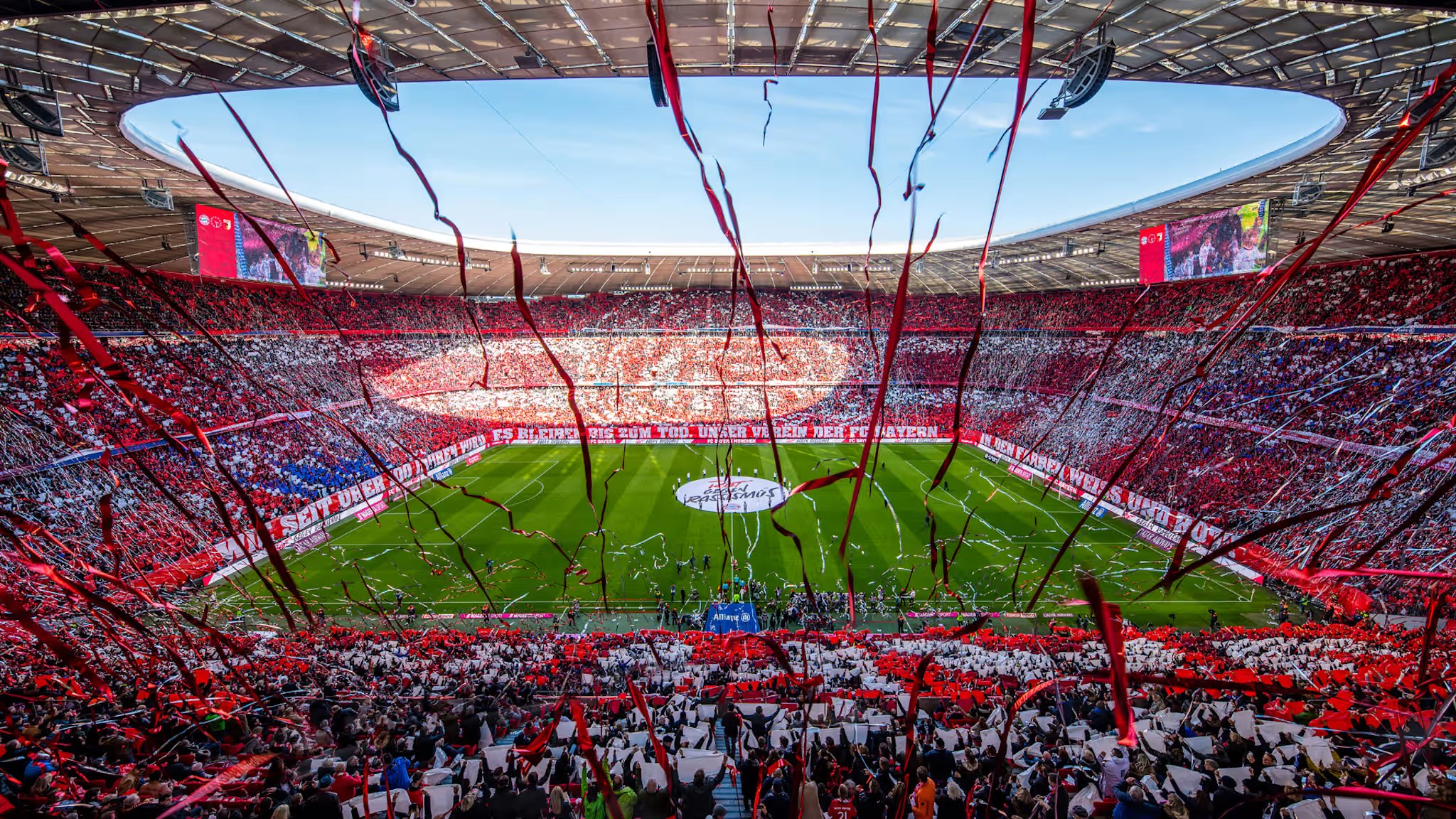
No. 04 · Munich, Bavaria, Germany
Allianz Arena – a glowing shell on the Bavarian plain
By night the Allianz Arena glows from within like a great red lantern, visible from the autobahn miles away. Inside is the most successful club in German history and one of the best-run institutions in world sport – a team that simply expects to win, in a city that has perfected the art of the good life. This is football's establishment, and it is magnificent.
The club
Bayern München were founded in 1900 and spent their early decades as one club among many in a football culture with no national league. Their rise to dominance came in the 1970s, built around three of the greatest players the game has produced: the elegant libero Franz Beckenbauer, who reinvented the role of the defender; the lethal striker Gerd Müller, whose goalscoring records stood for half a century; and the goalkeeper-captain Sepp Maier. Together they won three consecutive European Cups from 1974 to 1976 and gave Germany the spine of the team that won the 1974 World Cup at this club's old Olympiastadion.
What sets Bayern apart from other giants is the institution itself. Run for decades by its own former players – Beckenbauer, Rummenigge, Hoeneß – it became a model of stability and shrewd business, rarely in debt, almost never in crisis, forever winning. The German press call it "FC Hollywood" for the drama in its corridors, but the results never waver.
The modern peak came in 2013 – and again in 2020 – when Bayern won the treble of league, cup and Champions League, the 2020 side sweeping every competition it entered without losing a knockout game. Stars have passed through like a procession of royalty: Lothar Matthäus, Oliver Kahn, Philipp Lahm, Bastian Schweinsteiger, Thomas Müller, Robert Lewandowski. To pull on the Bayern shirt is to inherit the highest expectations in German sport: anything but a trophy is treated as failure.
Their rivalry with Borussia Dortmund – Der Klassiker – is the fixture that stops Germany. Bayern are cast, fairly or not, as the powerful establishment to Dortmund's romantic underdog. The Bavarians wear the role with a certain swagger; they've heard the neutrals cheering for the other side for years, and they keep winning anyway. Seen from inside the Allianz, that ruthlessness has its own thrilling beauty.
The club's motto, in Bavarian dialect, is "Mia san mia" – "We are who we are." It captures everything: the self-belief, the regional pride, the refusal to apologise for being the best. The Südkurve, Bayern's home end, is a serious, organised support that produces huge displays and sings without pause, puncturing the lazy myth that the Allianz is a quiet, corporate ground. On the right night it roars.
The Allianz in full red — title day at the home of the champions
A taste of the noise
The Südkurve in full voice, the Allianz lit red.
Inside the Allianz
The approach is a ritual in itself. You ride the U-Bahn north and emerge with the crowd as the Arena comes into view across the open ground – and at night, lit red, it genuinely makes people stop and gasp. The walk to the turnstiles is long and ceremonial, beer in hand (Munich does nothing without good beer), the Südkurve faithful streaming toward their end.
Find a sightline to the Südkurve, the southern stand, the heart of the real support. Before kick-off they raise huge choreographed displays, and the call-and-response of "Stern des Südens" – "Star of the South", the club anthem – rolls around the bowl. Each Bayern goal is met with the stadium announcer roaring the scorer's first name and 75,000 people bellowing back the surname. It's a simple thing, and it's electric.
What you'll notice, compared to Dortmund's chaos or Celtic's fervour, is a kind of imperial confidence. Bayern fans don't plead with their team; they expect. There's a calm certainty to the place, and then – when the moment comes – a release that reminds you the establishment can roar as loud as anyone.
A word on tickets
Bayern fill the Allianz almost every week, and members and season-ticket holders absorb the vast majority of seats. For a visitor, hospitality is the reliable route – and for Der Klassiker or a Champions League night, effectively the only one. We confirm your place in writing, well in advance.
A seat inside the red lantern, secured before you fly.
The city
Munich is the prosperous, beautiful capital of Bavaria – Germany's most distinct region, with its own dialect, its own dress, its own fierce identity. Munich likes to call itself "Millionendorf", the village of a million people, because for all its wealth and big-city polish it keeps a relaxed, almost provincial warmth. The Alps begin an hour to the south; the beer is the best in the world by local decree; and life is organised around enjoying both.
The historic centre radiates from Marienplatz, with its ornate town hall and the daily clockwork dance of the glockenspiel. The Viktualienmarkt food market and the cavernous Hofbräuhaus beer hall are gloriously touristy and worth every minute. And then there's the Englischer Garten, a park bigger than New York's Central Park, where locals sunbathe by the river and – improbably – surf a standing wave in the middle of the city.
This is a region built on beer and the ritual around it. Spend an afternoon in a biergarten beneath the chestnut trees, a litre Maß in front of you and a pretzel the size of your head. Eat Weißwurst (white veal sausage, traditionally before noon, with sweet mustard and a wheat beer), roast pork, dumplings. In autumn, Oktoberfest turns the whole city into the most joyful chaos imaginable – if your dates align, it's unforgettable, but reserve everything far ahead.
Bavarians are proud, traditional and, once the formalities are past, tremendously good company. There's a formality to first encounters that melts entirely over a shared table and a few beers. Within an afternoon in a biergarten you'll be deep in conversation with the strangers beside you – that's simply how it works here.
Three ways to do it
Every option includes a guaranteed seat and a curator who knows the songs. Prices per person; flights not included.
Travelling as four or more? Groups save 10–20%. Want to pair it with Oktoberfest? Tell us early – it books out months ahead. Ask for a tailored quote →
Begin
No payment, no commitment. Your curator replies within one working day with honest options and honest prices.
Last updated 25 June 2026. Operated by Timo Geissinger, Frankfurt am Main. Contact: hello@inside-the-noise.com
Name, email, optional phone, trip details; IP logged automatically.
To prepare a quote and reply. Legal basis: contract initiation (Art. 6(1)(b) GDPR).
Never sold. Shared only with hotels/partners for a confirmed trip and with email/analytics tools (IP anonymised).
We do not sell personal information.
Timo Geissinger
Inside the Noise
Sandweg 6c
60319 Frankfurt am Main
Germany
Email: hello@inside-the-noise.com
Timo Geissinger, address as above.
This site is currently in a validation phase. No binding offers are made and no payments are taken.