Founded
1900
No. 06 · Kaiserslautern, Palatinate, Germany
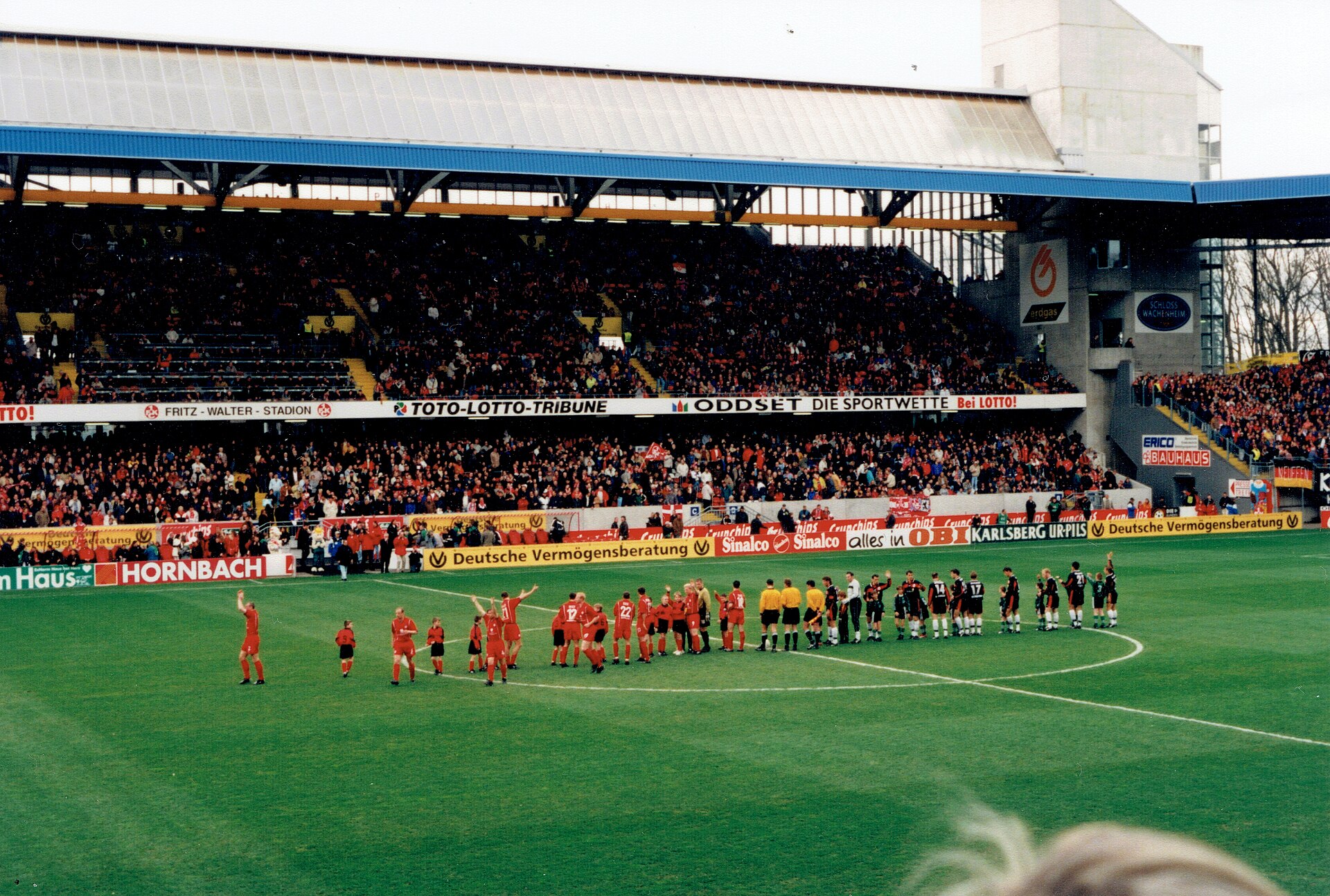
The Betzenberg – a fortress on the hill
This is the one only true believers know about – and the one they'll tell you is the most romantic of all. A club from a small town in the wooded hills, with a stadium perched on a slope called the Betzenberg, that once did the most impossible thing in German football. Kaiserslautern is not about the league it's in. It's about a feeling that outlasts every relegation: that this place, this hill, this team, is worth everything.
The club
Kaiserslautern is a town of barely 100,000 people in the Palatinate – a rural, wine-growing corner of south-west Germany of forests, vineyards and sandstone hills. By every logic of modern football it is far too small to matter. And yet 1. FC Kaiserslautern, "die Roten Teufel" – the Red Devils – have four German championships and a story that dwarfs clubs ten times their size.
At the centre of it stands one man: Fritz Walter. A one-club legend who played his entire career here, Walter captained West Germany to its first World Cup in the "Miracle of Bern" in 1954 – a victory so important to a defeated, divided post-war nation that it's often called the true birth of the modern Federal Republic. The stadium is named the Fritz-Walter-Stadion in his honour. To this day, soft rain on a matchday is called "Fritz-Walter-Wetter" – Fritz Walter weather – because he played his best in the wet.
And then there is 1998 – the season that makes grown fans cry to remember. Kaiserslautern had been relegated to the second division. They came straight back up as champions, and then, in their very first season back in the Bundesliga, as a newly-promoted team, they won the entire German league. No promoted club had ever done it before. None has done it since. Under the great Otto Rehhagel, a small-town team of unfashionable players humbled the giants of German football. It remains, simply, the most romantic title ever won in the country.
Football has not been kind since. Financial trouble and decline sent Kaiserslautern tumbling through the divisions, at one point all the way to the third tier – an unthinkable fate for a former champion of Europe's biggest games. And here is the thing that defines the club: the crowds never left. Even in the third division, tens of thousands climbed the Betzenberg every other week, singing as if nothing had changed. There is no clearer proof in German football that a club is loved for what it is, not for what it wins. Today they are back in the 2. Bundesliga, climbing again — and the Betze roars as if they never left the top.
Lautern is the connoisseur's choice – the club that fans of other clubs quietly admire. It has no glamour, no superstars, no fashionable cause. What it has is the purest distillation of why people love this game: a town and a team bound together through glory and ruin, on a hill in the forest, refusing to let go.
The Westkurve, climbing the Betzenberg
A taste of the noise
The Westkurve on a big night – atmosphere far too big for the league.
Inside the Betzenberg
The whole town turns out. In a place this size, there's no separating the club from the community – on a matchday the streets of Kaiserslautern are simply full of red, and the walk up the hill to the stadium is a procession of generations: grandfathers who remember 1954, parents who wept in 1998, kids learning the songs. The bars and the wine stands (this is wine country, not just beer) hum from midday.
The stadium itself is special precisely because it's built into the slope – the Westkurve, the home end, rises steeply above the pitch, and when it's full and roaring it feels like the noise is coming down the mountain at you. For a club outside the top flight, the volume astonishes first-time visitors. These are people who have followed their team to the third division and back; they do not need a Champions League night to sing their lungs out.
What you feel here is something the bigger grounds have partly lost: football as the absolute centre of a community's life. There's no corporate gloss, no influencer in the front row. Just a town and its team, on a hill, in the rain if you're lucky – Fritz-Walter-Wetter – doing the thing they've done together for over a hundred years.
A word on tickets
This is the most affordable ground we offer, and the most authentic – but big games on the Betze still draw close to 50,000 and sell out fast. We secure your seat in writing and, because the town is small, we take particular care with the right hotel and the right local welcome.
The hidden gem of German football, arranged with care.
The town & region
Kaiserslautern sits in the Palatinate (die Pfalz) – one of Germany's warmest, most easygoing regions, a sun-trap of vineyards and orchards pressed against the largest contiguous forest in the country, the Pfälzerwald. This is not the Germany of the guidebooks; it's the Germany Germans go to relax. The pace is gentle, the food is generous, and the wine – especially Riesling – is among the best in the world.
The town itself is unpretentious and human-scaled, rebuilt after wartime damage around its old market squares. (There's a curious thread of American history here, too: the region has hosted large US military communities for decades, so the welcome to an American visitor comes with genuine familiarity.) But the real treasure is the countryside on its doorstep – castle ruins on forested crags, sandstone cliffs, and a string of impossibly pretty wine villages along the German Wine Route, the oldest of its kind in the world.
The Palatinate eats heartily and proudly. The signature dish is Saumagen – humble in origin, beloved enough that a local-born Chancellor, Helmut Kohl, used to serve it to visiting world leaders. Pair it, as the locals do, with a Schorle (wine cut with sparkling water, drunk by the half-litre) and a glass of proper Riesling. Cosy wine taverns, the Weinstuben, are the heart of social life and the warmest rooms in Germany on a cold night.
Palatines are famously relaxed, warm and fond of a good time – closer in temperament to their French neighbours across the border than to the buttoned-up north. They are delighted, and slightly amazed, when an American turns up to climb the Betzenberg, and they will look after you accordingly. Come here and you'll see a side of Germany almost no tourist ever does.
Three ways to do it
Every option includes a guaranteed seat and a curator who knows the songs. Prices per person; flights not included.
Travelling as four or more? Groups save 10–20%. Ask for a tailored quote →
Begin
No payment, no commitment. Your curator replies within one working day with honest options and honest prices.
Last updated 25 June 2026. Operated by Timo Geissinger, Frankfurt am Main. Contact: hello@inside-the-noise.com
Name, email, optional phone, trip details; IP logged automatically.
To prepare a quote and reply. Legal basis: contract initiation (Art. 6(1)(b) GDPR).
Never sold. Shared only with hotels/partners for a confirmed trip and with email/analytics tools (IP anonymised).
We do not sell personal information.
Timo Geissinger
Inside the Noise
Sandweg 6c
60319 Frankfurt am Main
Germany
Email: hello@inside-the-noise.com
Timo Geissinger, address as above.
This site is currently in a validation phase. No binding offers are made and no payments are taken.