Founded
1910
No. 05 · St. Pauli, Hamburg, Germany
The Millerntor – football under the skull and crossbones
There is one football club on earth whose badge is a skull and crossbones, whose anthem is by an English punk band, and whose fans will tell you the result barely matters next to what the club stands for. FC St. Pauli is not about trophies. It's about a neighbourhood, a politics, and a refusal – and it has become, improbably, one of the most beloved cult clubs in the world.
The club
St. Pauli is a district of Hamburg wrapped around the Reeperbahn – Europe's most notorious red-light strip, a neon mile of bars, clubs, sailors and misfits. The football club that grew here took on the character of the place: scruffy, tolerant, suspicious of authority, a home for everyone the respectable city looked down on. For most of its life it was a small, unremarkable team bouncing between the lower divisions.
Everything changed in the 1980s. As the docklands around the Reeperbahn became a hub of punks, squatters and left-wing activists, they adopted the local club – and the club adopted them back. Fans raised the Totenkopf, the skull and crossbones, on the terraces. The Millerntor became the first ground in Germany to ban far-right and racist displays. St. Pauli declared itself, openly and proudly, an antifascist, anti-racist, anti-homophobic football club – a stance unheard of in the sport at the time, and central to its identity ever since.
The result is something genuinely unique. St. Pauli sells more merchandise than its results could ever justify, because hundreds of thousands of people around the world wear the skull not as glory-hunters but as a statement of values. Its supporters' clubs span the globe – including a passionate American following. When the team runs out, the Millerntor plays AC/DC's "Hells Bells", and after every home goal the crowd roars to "Song 2" by Blur – the "woo-hoo" you already know.
And here's the lovely paradox: for all the politics, this is one of the warmest, funniest, most welcoming grounds you will ever visit. There's no aggression in the air, just a packed, joyful, slightly chaotic celebration of belonging. It feels less like a sporting fixture than a neighbourhood throwing a party for itself, every other Saturday.
The big rival is Hamburger SV, the city's traditional, establishment club – the "Dino" of German football. The Hamburg derby is fierce, but the rivalry is as much about identity as football: working-class, alternative St. Pauli against buttoned-up, mainstream HSV. To support St. Pauli is, in part, to choose a side in an argument about what kind of city – and what kind of game – you want.
The Millerntor – small, loud, and entirely its own thing
A taste of the noise
The Millerntor erupts as Hells Bells tolls.
Inside the Millerntor
The pre-match happens in the bars of the Reeperbahn and the side streets around it – and unlike anywhere else, the football crowd simply blends into the district's permanent carnival of punks, tourists, locals and night-owls. There's no segregation of the experience from the city; the club is the neighbourhood and the neighbourhood is the club. Have a beer at a streetside stand, soak up the most gloriously disreputable square mile in Germany, and drift toward the ground with everyone else.
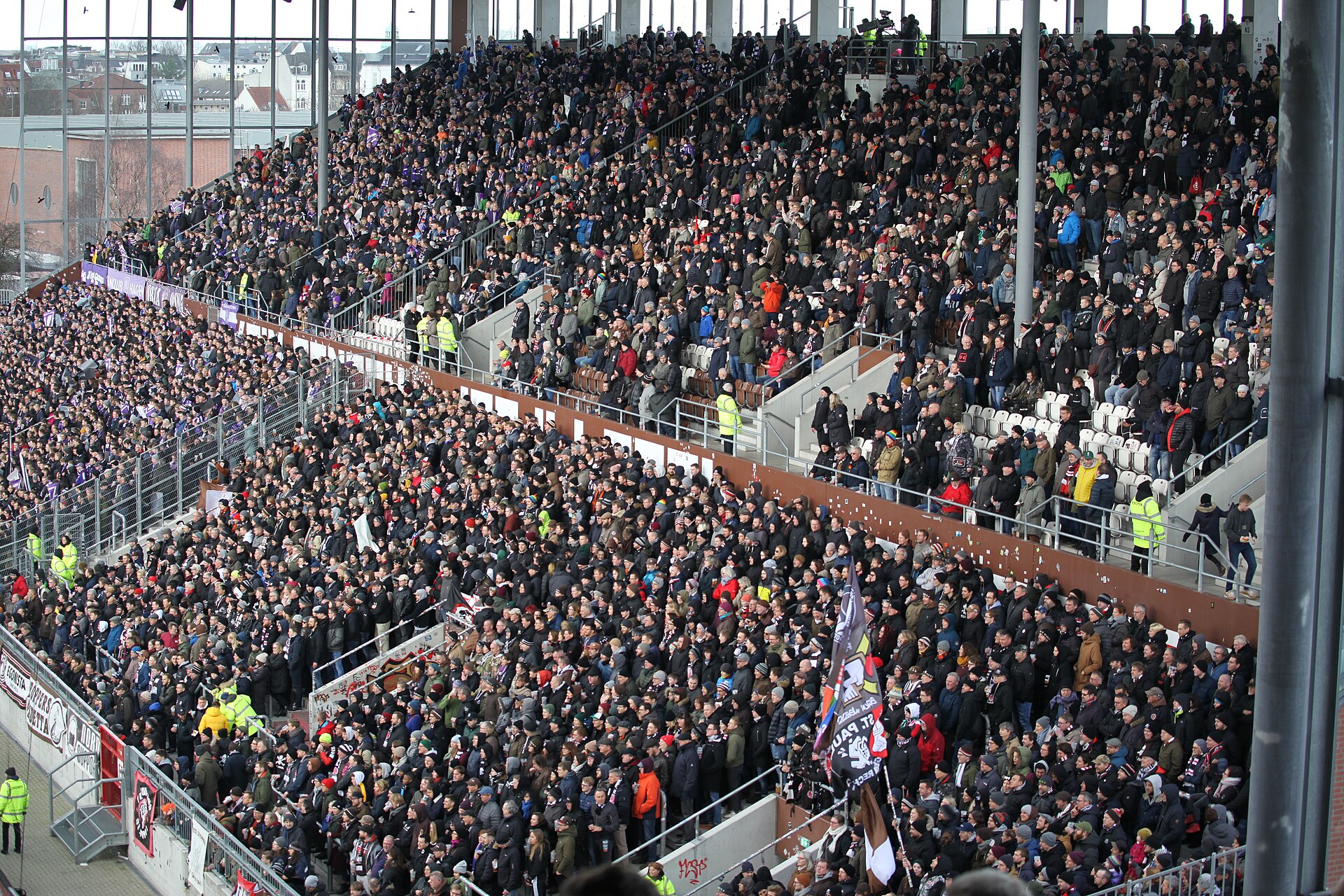
The Millerntor is small – under 30,000 – and that's the point. You're close to the pitch, packed in, part of it. "Hells Bells" tolls as the team emerges and the whole ground answers. The terraces are a forest of skull-and-crossbones flags and home-made banners, many of them political, many of them funny. When St. Pauli score, Blur's "Song 2" detonates and 29,000 people bounce and bellow the "woo-hoo" in unison.
What stays with visitors isn't the football – often it's second-division, scrappy, beside the point – but the feeling. It is the least cynical, most openly affectionate atmosphere in the game. People are there because they love the club and what it means, win or lose, and they fold a respectful stranger into that without a second thought.
A word on tickets
Because the Millerntor is tiny and the support is fanatical, home games sell out as a matter of routine – it's one of the toughest tickets in German football despite the division. We secure your place properly and in writing, so the most loved cult club in the world is actually within reach.
A spot under the skull and crossbones, arranged before you fly.
The city
Hamburg is Germany's great port – a wealthy, watery, surprisingly cool city of canals, red-brick warehouses and more bridges than Venice and Amsterdam combined. For centuries it was a free, self-governing merchant city that looked out to the world's oceans rather than inward to Germany, and it carries a certain cosmopolitan, slightly reserved confidence as a result. It is also the birthplace, more or less, of the Beatles – they grew up as a band in the clubs of the Reeperbahn, playing eight-hour sets to sailors and gangsters.
The Reeperbahn, in the St. Pauli district, is the famous heart of the nightlife – equal parts seedy and joyous, and far more fun than its reputation suggests. But Hamburg is also strikingly elegant: the gleaming Elbphilharmonie concert hall rising over the harbour, the UNESCO-listed Speicherstadt warehouse district, the great lake of the Alster in the middle of town. The early-morning Sunday Fischmarkt, where night-owls and fishmongers collide, is a Hamburg institution.
This is northern, maritime Germany, so the food leans to the sea: a Fischbrötchen (fresh fish in a bread roll) from a harbour stand is the essential cheap lunch. Try Labskaus, the sailor's dish of corned beef, beetroot and fried egg, if you're feeling brave. The craft-beer and bar scene around the Schanze and St. Pauli is among the best in the country, and it runs very, very late.
Hamburgers have a reputation for northern coolness – polite, understated, not quick to gush. But the St. Pauli quarter is the exception that proves the rule: open, alternative, and warm to anyone who arrives without airs. It's the part of this reserved city that hugs strangers, and the football club is its beating heart.
Three ways to do it
Every option includes a guaranteed seat and a curator who knows the songs. Prices per person; flights not included.
Travelling as four or more? Groups save 10–20%. Ask for a tailored quote →
Begin
No payment, no commitment. Your curator replies within one working day with honest options and honest prices.
Last updated 25 June 2026. Operated by Timo Geissinger, Frankfurt am Main. Contact: hello@inside-the-noise.com
Name, email, optional phone, trip details; IP logged automatically.
To prepare a quote and reply. Legal basis: contract initiation (Art. 6(1)(b) GDPR).
Never sold. Shared only with hotels/partners for a confirmed trip and with email/analytics tools (IP anonymised).
We do not sell personal information.
Timo Geissinger
Inside the Noise
Sandweg 6c
60319 Frankfurt am Main
Germany
Email: hello@inside-the-noise.com
Timo Geissinger, address as above.
This site is currently in a validation phase. No binding offers are made and no payments are taken.