Founded
1887
No. 02 · Glasgow, Scotland
Celtic Park – the ground they call Paradise
UEFA once measured the noise inside Celtic Park and found it could top 130 decibels – louder than a jet at take-off. But the number isn't the story. The story is a football club founded to feed starving Irish immigrants, that became the first British team to conquer Europe with eleven men born within thirty miles of the ground. There is nowhere in Britain quite like it.
The club
Celtic were founded in 1887 by an Irish Marist brother, Brother Walfrid, with a purpose that had nothing to do with trophies: to raise money to feed the poor Irish-Catholic children of Glasgow's East End. The city had swelled with families fleeing the Famine, and they met poverty and prejudice in equal measure. A football club, Walfrid reasoned, could fund the soup kitchens – and give a scattered, scorned community something to call its own.
It worked beyond anyone's dream. Within a generation Celtic were among the best teams in the world, and the club's Irish-Catholic identity – the green and white, the shamrock on the crest – became a banner for a people. To this day the support sings the songs of Ireland as readily as the songs of Glasgow.
On 25 May 1967, Celtic did something no British club had ever done: they won the European Cup. They beat the cynical, defensive Inter Milan 2–1 in Lisbon by attacking from the first whistle to the last, managed by the great Jock Stein, the son of a Lanarkshire miner. The astonishing part: every single player in that team was born within ten miles of Celtic Park. A local team, in the truest sense, became champions of Europe. They have been the Lisbon Lions ever since, and their names are spoken at the ground like scripture.
You cannot understand Celtic without Rangers, their city rivals from across Glasgow. The Old Firm is the oldest and fiercest derby in world football, and it is about far more than football – it carries the city's old fault lines of religion, Irish and British identity, Catholic and Protestant. The two clubs have dominated Scottish football for over a century. When they meet, the city holds its breath. It is intense, occasionally ugly, and unlike anything in American sport – closer to a civic event than a game.
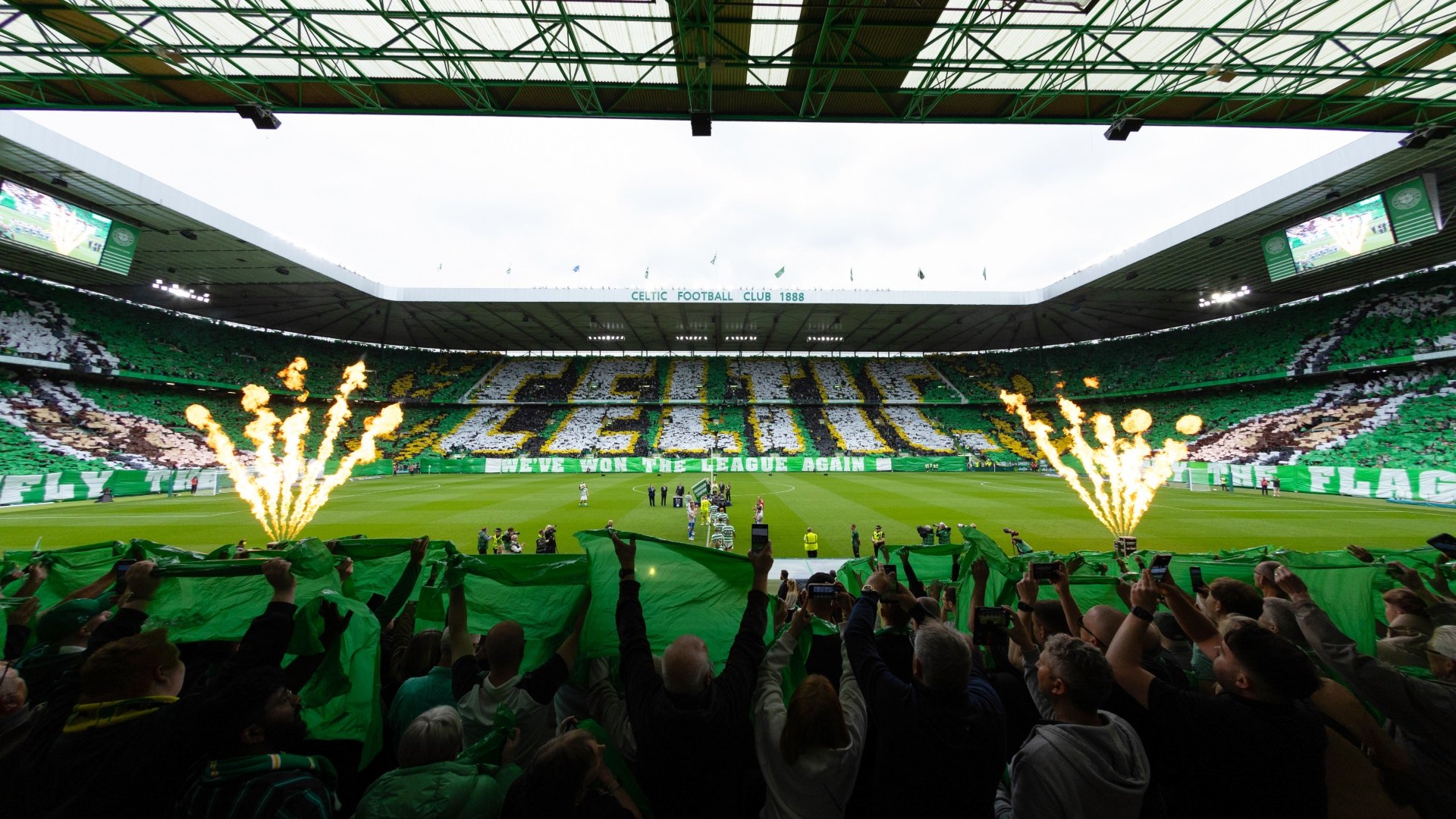
Today Celtic Park's noise is led by the Green Brigade, an ultras group in the standing North Curve who produce vast, breathtaking tifo displays and never, ever stop singing. On a European night, the pre-match rendition of "You'll Never Walk Alone" – yes, this club too – followed by a wall of green flame and 60,000 voices, is one of the genuine wonders of the sport.
The North Curve before a European night
A taste of the noise
Celtic Park, a European night – the loudest 60,000 in Britain.
Inside Celtic Park
The East End fills early. The famous Celtic pubs – The Brazen Head in the Gorbals, Bairds Bar, the social clubs around the Gallowgate – open their doors to a sea of green hours before kick-off, rebel songs and Glasgow banter spilling onto the street. This is a working-class district that has never pretended otherwise, and the welcome to a respectful visitor is enormous.
Inside, find your way to a view of the North Curve. When the Green Brigade unfurl a tifo it can cover an entire stand – a hand-painted mural three storeys high, passed up over thousands of heads. The singing doesn't pause for ninety minutes. "The Celtic Song", "Grace", "The Fields of Athenry" – a lament for the Famine that has become the most moving anthem in the game. When a full house sings "Athenry", grown strangers put arms around each other. You will not stay dry-eyed.
And then there's the moment after a goal, when sixty thousand people lose their minds at once and the old stadium genuinely shakes beneath your feet. Paradise is not an exaggeration the support invented to be cute. On the right night, it's just accurate.
A word on tickets
Celtic's season-ticket base fills most of the ground before a single seat reaches general sale, and the Old Firm is effectively impossible through normal channels. Hospitality is the dependable way in for a visitor – and the way we secure your place, confirmed in writing.
A seat in Paradise, arranged before you leave home.
The city
Glasgow is Scotland's biggest city and its beating, slightly battered heart. Edinburgh has the castle and the tourists; Glasgow has the music, the art, the nightlife and the people. It made its fortune as an industrial powerhouse – shipbuilding on the Clyde, "second city of the Empire" – and when that collapsed it reinvented itself through culture, sheer attitude and one of the great senses of humour on the planet. Glaswegians are widely held to be the friendliest people in Britain, and they are also merciless slaggers; the two are not in conflict.
The architecture is grander than you expect – soot-darkened Victorian sandstone, the curves of Charles Rennie Mackintosh, the spectacular Kelvingrove Art Gallery. The West End is leafy and bohemian; the Merchant City is bars and restaurants in old tobacco warehouses; Finnieston has become one of Britain's best places to eat. And running underneath all of it is music – Glasgow has produced an astonishing run of bands, and on any night the small venues are full.
This is whisky country – ask any bar for a flight and let them guide you from a soft Speyside to a peaty Islay that tastes of bonfires and the sea. Eat well in Finnieston (the seafood is superb), and at least once have the gloriously unhealthy Scottish staples: a proper fry-up, and yes, a deep-fried Mars bar, ordered with the irony the locals intend. Pub culture is warm and democratic; nobody cares where you're from once you've bought a round.
Be warned and delighted: the Glaswegian accent is the hardest in the English-speaking world, fast and full of slang. You will understand perhaps 70% at first. Smile, ask them to say it again, and within a day you'll be calling things "pure dead brilliant" too.
Three ways to do it
Every option includes a guaranteed seat and a curator who knows the songs. Prices per person; flights not included.
Travelling as four or more? Groups save 10–20%. Want the Old Firm? Tell us – it's the hardest ticket in Scotland, and we'll be honest about it. Ask for a tailored quote →
Begin
No payment, no commitment. Your curator replies within one working day with honest options and honest prices.
Last updated 25 June 2026. Operated by Timo Geissinger, Frankfurt am Main. Contact: hello@inside-the-noise.com
Name, email, optional phone, trip details; IP logged automatically.
To prepare a quote and reply. Legal basis: contract initiation (Art. 6(1)(b) GDPR).
Never sold. Shared only with hotels/partners for a confirmed trip and with email/analytics tools (IP anonymised).
We do not sell personal information.
Timo Geissinger
Inside the Noise
Sandweg 6c
60319 Frankfurt am Main
Germany
Email: hello@inside-the-noise.com
Timo Geissinger, address as above.
This site is currently in a validation phase. No binding offers are made and no payments are taken.