Founded
1909
No. 03 · Dortmund, Germany
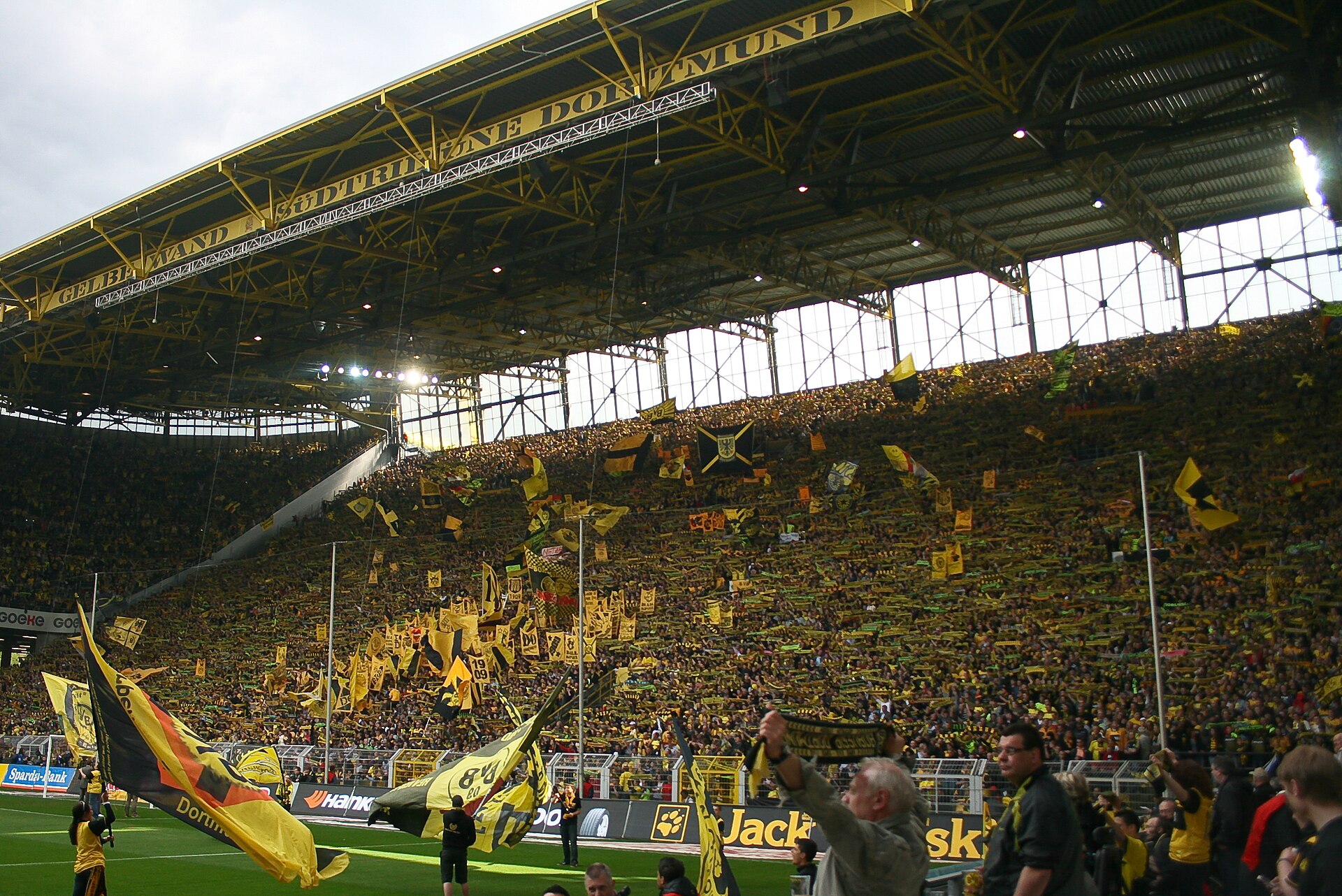
Signal Iduna Park – and the largest terrace in Europe
Twenty-five thousand people, standing, on one vast bank of terracing – the Südtribüne, the Yellow Wall, the biggest standing stand in European football. When Dortmund score, it doesn't cheer so much as erupt, and the whole structure bounces. This is German football's great democratic spectacle: cheap tickets, beer in the stand, and a club that belongs, by law, to its members.
The club
Borussia Dortmund were founded in 1909 by a group of young men in the back room of a pub called Zum Wildschütz, in open defiance of a local priest who disapproved of football. That mix – working-class, slightly rebellious, rooted in a single neighbourhood – never left. Dortmund is a coal-and-steel city in the heart of the Ruhrgebiet, Germany's industrial engine, and the club has always carried the identity of the men who went down the mines.
Like all German clubs, BVB lives under the "50+1" rule: members hold a majority of the voting rights, so no oligarch or corporation can buy the soul of the club. It's why tickets are affordable, why standing terraces survive, and why German football feels like it belongs to the people in the stands rather than to a billionaire's trophy cabinet. Dortmund is the loudest argument for that model anywhere.
It nearly all ended in 2005. Reckless spending left Dortmund on the edge of bankruptcy, some €200 million in debt – saved, humiliatingly, by an emergency loan from their great rivals Bayern, who didn't want the Bundesliga to lose one of its giants. From that low came one of football's great rebirths.
A young, charismatic manager named Jürgen Klopp arrived in 2008 and built a team in his own image: young, fearless, pressing opponents into submission, playing with a joy that lit up Europe. They won back-to-back Bundesliga titles in 2011 and 2012, the second with a record points haul, and reached the 2013 Champions League final at Wembley. They lost that night to Bayern – the eternal story of the club, glorious and heartbreaking in the same breath – but they had announced themselves to the world.
Modern Dortmund has a particular genius: finding the best young players on earth, making them brilliant, and selling them on for fortunes. Erling Haaland, Jude Bellingham, Ousmane Dembélé, and – close to American hearts – Christian Pulisic, the USMNT captain who became a star on this very pitch. To watch Dortmund is often to watch a global superstar a year or two before the rest of the world catches on.
Dortmund versus Bayern München is the defining rivalry of German football – "Der Klassiker." It's the people's club against the establishment, the Ruhr against Bavaria, romance against ruthless efficiency. Bayern usually win the league. Dortmund usually win the neutral's heart. Ask a German with no skin in the game who they'd rather see lifted, and nine times out of ten it's the yellow.
The Südtribüne – 25,000, all standing
A taste of the noise
The Südtribüne, Signal Iduna Park – this is what you'll stand in.
Inside Signal Iduna Park
It begins around Borsigplatz, the old square in the working-class north where the club was born, where ultras gather and march. The road to the ground, Strobelallee, becomes a river of yellow – bratwurst smoke, beer stands, scarves, families and hardcore alike. German football is gloriously unpretentious: you'll have a half-litre of Veltins in your hand within minutes of arriving, served in a reusable cup with a small deposit.
If you're not used to standing for two hours, take a seat elsewhere in the ground – but get yourself a view of the Südtribüne, because seeing it is half the reason you came. Before kick-off the whole stadium sings "You'll Never Walk Alone" (adopted here in the '90s), and then the Wall takes over and simply does not stop. The choreography – vast banners, coordinated card displays – is organised by the fans themselves, for no reward but the spectacle.
When Dortmund score, watch the Wall, not the pitch. Twenty-five thousand people leave the ground at the same instant, arms up, a single yellow animal. The terrace flexes. Cameras can't hold it. It is, quite simply, one of the things you should see once in your life.
A word on tickets
Terrace tickets cost a fraction of an American game, which is precisely why members snap them up in moments and big fixtures sell out instantly. We secure seated or standing places – hospitality for the marquee matches – confirmed in writing, well ahead.
A place at the Wall, sorted before you fly.
The city & region
Dortmund won't seduce you the way Munich or Hamburg might, and it doesn't try to. This is the Ruhrgebiet – for over a century the industrial furnace of Germany, a dense belt of cities built on coal and steel, on immigrant labour and union solidarity. The mines and mills have largely closed, and the region has spent a generation reinventing itself as a place of museums, parks, universities and start-ups, often inside the cathedral-like ruins of its industrial past.
The single best example is Zollverein, a short trip away in Essen – a vast, beautiful former coal mine and coking plant, now a UNESCO World Heritage Site full of galleries, design museums and, in winter, an ice rink threaded between the old machinery. It's a moving, strangely gorgeous monument to the world that built this region. In Dortmund itself, the Dortmunder U – a converted brewery tower that glows gold at night – anchors a lively arts scene.
Dortmund was once one of the great brewing cities of Europe, and beer is taken seriously: a cold, crisp Pilsner is the regional religion. Eat honestly and well – currywurst (sliced sausage in spiced ketchup, which the region will tell you it perfected), a proper schnitzel, hearty stews like Pfefferpotthast. The food is unfussy and generous, like the people.
Ruhr folk are famously direct – no small talk, no airs. They'll tell you exactly what they think, buy you a beer, and consider both gestures equally friendly. After a few days of polished tourist towns, the bluntness is a tonic. There's a warmth under it that you earn quickly and keep.
Three ways to do it
Every option includes a guaranteed seat and a curator who knows the songs. Prices per person; flights not included.
Travelling as four or more? Groups save 10–20%. Ask for a tailored quote →
Begin
No payment, no commitment. Your curator replies within one working day with honest options and honest prices.
Last updated 25 June 2026. Operated by Timo Geissinger, Frankfurt am Main. Contact: hello@inside-the-noise.com
Name, email, optional phone, trip details; IP logged automatically.
To prepare a quote and reply. Legal basis: contract initiation (Art. 6(1)(b) GDPR).
Never sold. Shared only with hotels/partners for a confirmed trip and with email/analytics tools (IP anonymised).
We do not sell personal information.
Timo Geissinger
Inside the Noise
Sandweg 6c
60319 Frankfurt am Main
Germany
Email: hello@inside-the-noise.com
Timo Geissinger, address as above.
This site is currently in a validation phase. No binding offers are made and no payments are taken.