Founded
1892
No. 01 · Merseyside, England
Anfield – where a football ground learned to sing
There are bigger clubs and richer ones. There is no louder act of devotion in English football than forty thousand people on the Kop, scarves above their heads, singing a show tune from 1945 as though their lives turned on it. This is the story of how that happened – and of the strange, brilliant city that needed it.
The club
Liverpool Football Club exists because of a falling-out. In 1892 the owner of Anfield, John Houlding, quarrelled with the tenants – Everton – over the rent on the ground. Everton walked across Stanley Park and built Goodison. Houlding was left with a stadium and no team, so he made one. The two clubs have shared the city, and loathed sharing it, ever since.
For its first seventy years Liverpool were good, occasionally great, never mythic. That changed when a chain-smoking Scottish socialist named Bill Shankly arrived in 1959 to a second-division club with a training ground he described as a wilderness. Shankly didn't just build a team; he built a faith. "Football is not a matter of life and death," he said. "It's much more important than that." He meant the bond between a working town and the eleven men who carried its name.
What Shankly began, Bob Paisley turned into an empire. A quiet man from a County Durham mining village, Paisley remains the most decorated manager English football has produced: three European Cups in nine years, a wall of league titles, a side that pressed and passed before anyone had the vocabulary for it. Through the 1970s and 80s, Liverpool simply expected to win Europe – and usually did.
Then came the grief that the club will never put down. Heysel in 1985. And Hillsborough in 1989, where 97 Liverpool supporters were crushed to death at an FA Cup semi-final, followed by decades of lies blaming the dead. The fight for the truth, led by the families, is woven into what it means to support this club. "Justice for the 96" – now 97 – is not a slogan here. It is the reason you'll see no one mock the dead at Anfield, and why the away end is asked, always, to respect the silence.
The titles stopped in 1990. Generations of Liverpudlians grew up, married and grew old without seeing their club crowned champions of England – even as the European nights kept the faith alive, none more impossible than Istanbul, 2005, three goals down to Milan at half-time and somehow, madly, champions of Europe by midnight.
It took a German with a gap-toothed grin to end the drought. Jürgen Klopp arrived in 2015 and told a deflated city to turn doubters into believers. In 2019 he won a sixth European Cup; in 2020, at last, the league. The streets were empty that night – a pandemic kept them home – but you could hear the city through open windows, weeping and roaring at once. Thirty years. Gone.
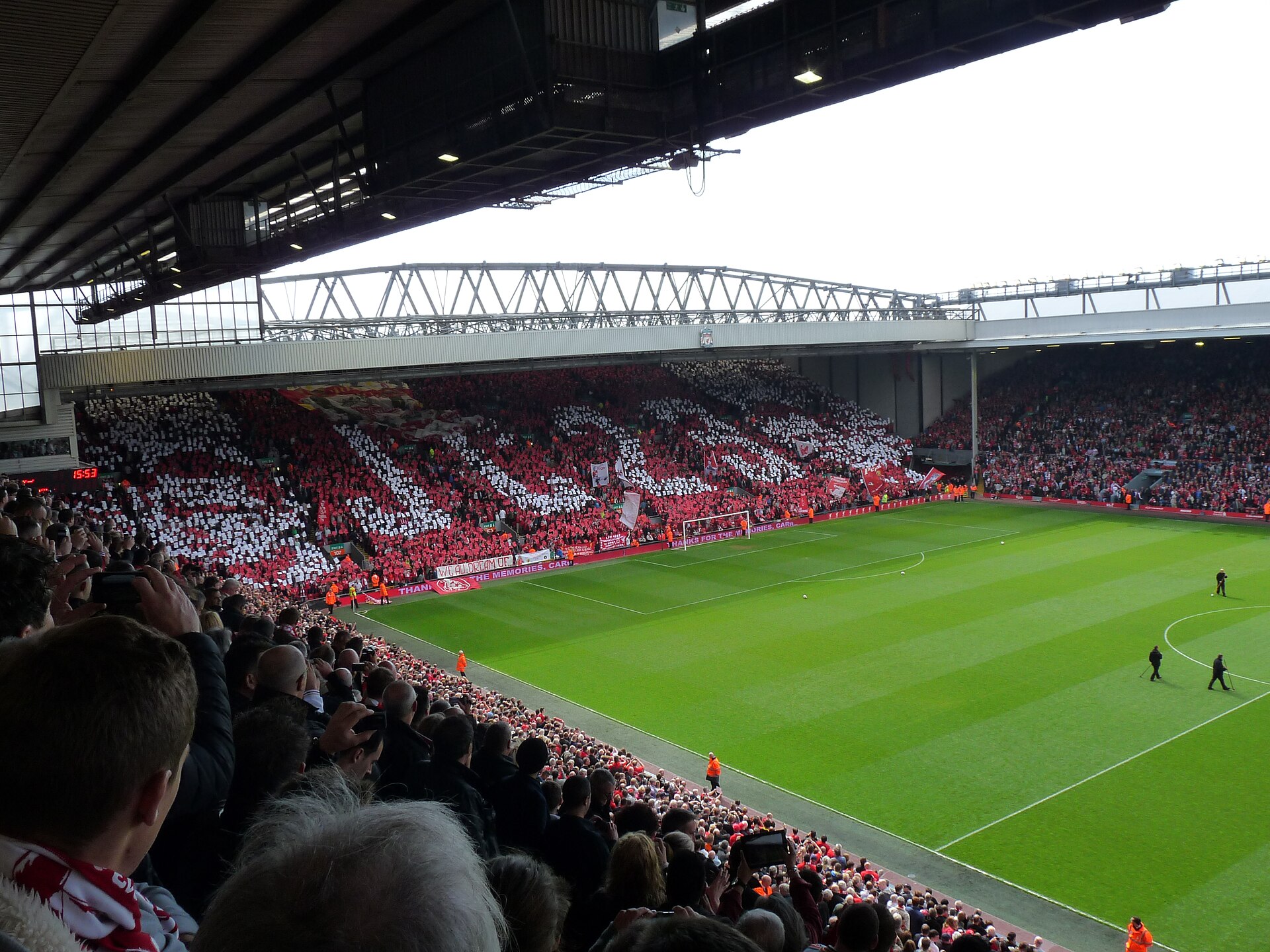
Five minutes to kick-off – the scarves go up
A taste of the noise
Anfield, five minutes to kick-off – the hymn, the scarves, the hair on your neck.
Inside Anfield
The day starts in the pubs long before the gates open. Regulars gather at The Sandon – the very building where the club was founded – and at the cluster of houses-turned-bars along Walton Breck Road. Pints, pies, a beef drink called Bovril, and songs rehearsed until the words are muscle memory. Arrive three hours early. The build-up is the experience.
Then the walk. Ninety minutes before kick-off, Anfield Road thickens with red, the smell of fried onions, the chant rising and falling in waves. You pass the Shankly Gates, the words "You'll Never Walk Alone" worked into the iron, and the eternal flame for the 97. Phones come out. Then they go away, because what comes next isn't for filming.
The anthem lands five minutes before kick-off. The whole ground – not a section, the whole ground – sings Gerry & The Pacemakers, scarves stretched overhead, and for ninety seconds the hard city is soft. Opposition players have admitted, on record, that it unsettles them. Liverpool players say it lifts tired legs in the eighty-ninth minute. You will not be able to explain it to people at home. You'll just say: you had to be there.
A word on tickets
Anfield runs on membership and a ballot. General-sale tickets, when they appear at all, are gone in seconds. For a visitor from overseas, the regular route is effectively closed. Hospitality is the honest, reliable way in – and it's the route we use, secured in writing, weeks ahead.
We don't promise to try. We confirm your seat before you book a flight.
The city
Liverpool has always been a little apart from the rest of England – and proud of it. It grew rich and infamous as the British Empire's great Atlantic port, its docks handling cotton, sugar and, shamefully, the slave trade the city now confronts honestly in its International Slavery Museum. Waves of Irish, Welsh, Caribbean and Chinese arrivals made it the most mongrel, outward-looking city in the country. The accent – the fast, nasal, sing-song "Scouse" – is the sound of all of it mixed together.
That openness made the music. Liverpool gave the world the Beatles, and you feel it everywhere: the rebuilt Cavern Club where they played 292 times, still sweaty and loud most nights; the childhood homes; the bars where their faces hang on every wall. But the city wears it lightly – it's a working town that happened to invent modern pop, not a theme park about it.
Try scouse, the lamb-and-root-vegetable stew the locals are named after – warm, cheap, exactly right after a cold terrace. Sunday means a roast: beef, Yorkshire pudding, a flood of gravy. And the pubs are half the point. The Philharmonic Dining Rooms is a Grade-listed palace with the most beautiful gents' toilets in Britain (genuinely – ask). Ye Cracke was Lennon's local. The Baltic Triangle is where the city drinks now – breweries, street food, no tourists.
Scousers are quick, warm, and merciless in the best way. If a stranger takes the mickey out of you, relax – it means they've decided they like you. Give it back and you'll have a friend for the weekend. There is nowhere in England easier to fall into conversation, or harder to leave.
Three ways to do it
Every option includes a guaranteed seat and a curator who knows the songs. Prices per person; flights not included.
Travelling as four or more? Groups save 10–20%. Ask for a tailored quote →
Begin
No payment, no commitment. Your curator replies within one working day with honest options and honest prices.
Last updated 25 June 2026. Operated by Timo Geissinger, Frankfurt am Main. Contact: hello@inside-the-noise.com
Name, email, optional phone, trip details; IP logged automatically.
To prepare a quote and reply. Legal basis: contract initiation (Art. 6(1)(b) GDPR).
Never sold. Shared only with hotels/partners for a confirmed trip and with email/analytics tools (IP anonymised).
We do not sell personal information.
Timo Geissinger
Inside the Noise
Sandweg 6c
60319 Frankfurt am Main
Germany
Email: hello@inside-the-noise.com
Timo Geissinger, address as above.
This site is currently in a validation phase. No binding offers are made and no payments are taken.